机器学习理论论文 LaTeX 通用素材库#
这是一组可以直接复制到机器学习理论论文里的 LaTeX 写作素材。
它不是完整论文模板,而是更小粒度的“句式 + 环境 + 排版”片段,适合在写 introduction、definition、theorem、lemma、proof 和公式解释时快速复用。
使用时建议先关注三件事:
- 先明确功能:这个片段是用来提出问题、定义对象、陈述结论,还是解释公式。
- 再替换符号:保留叙述结构,把变量、矩阵、误差项替换成自己的对象。
- 最后统一风格:同一篇论文里的 theorem、lemma、proof 和强调框要保持一致。
说明:下方每个小节都包含源码和编译预览。
\questionbox、\Mask、\DM等命令是示例中的自定义宏,实际使用时可以换成你论文里的宏定义。
素材总览#
| 编号 | 类型 | 适合场景 |
|---|---|---|
| 01 | 强调性研究问题 | 引言末尾、problem statement |
| 02 | 定义环境 | 定义模型、对象、递推结构 |
| 03 | 主结果定理 | 陈述核心上界、分解结论、阶段性结论 |
| 04 | 短引理 | 证明链中的局部工具结论 |
| 05 | 引理与证明 | 用 2—3 句说明关键因果链 |
| 06 | 行内小标题 | 在一节内部切换叙述焦点 |
| 07 | 编号式加粗说明 | 拆解 theorem 或公式中的多个成分 |
| 08 | 粗斜体强调句 | 段首总结机制或核心观察 |
| 09 | 公式后立即解释 | 先给公式,再解释每个符号的功能 |
| 10 | 由公式过渡到定理 | 公式、直觉解释、theorem 的自然衔接 |
01. Boxed question / 强调性研究问题#
用于把核心研究问题单独拎出来,形成视觉停顿。适合引言末尾或 problem statement。
\questionbox{How do semantic associations emerge during the training of attention-based language models on natural language data?}
02. Definition + displayed equations / 定义环境#
先定义对象,再给递推公式,最后补符号解释。是理论论文中很常见的定义写法。
\begin{definition}[Attention-Based Transformer]
Given an input matrix $X \in \mathbb{R}^{T \times |\mathcal V|}$ and parameters $\Theta$, define
\begin{equation}
F_{\Theta}(X)=h^{(L)}W_O,
\end{equation}
where
\begin{equation}
h^{(l)} = h^{(l-1)} +
S\!\left(\Mask\!\left(h^{(l-1)}W^{(l)}h^{(l-1)\top} + \DM(P^{(l)})\right)\right)
h^{(l-1)}V^{(l)},
\qquad
h^{(0)} = X.
\end{equation}
Here, $S(\cdot)$ denotes softmax, $\DM(\cdot)$ maps a vector to a relative-position bias matrix, and $\Mask(\cdot)$ applies the causal mask.
\end{definition}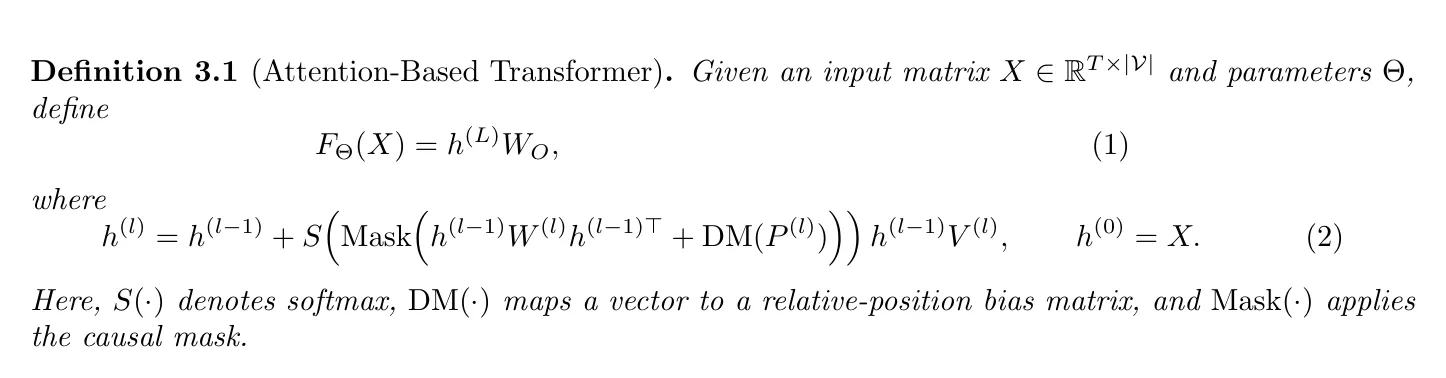
03. Theorem + align / 主结果定理#
把主结果压缩为并列不等式组,再用一句话解释各项含义。适合 early-stage training、误差上界、分解结论等场景。
\begin{theorem}[Informal]
Under sufficiently small initialization, after $s$ gradient-descent steps with learning rate $\eta$, the early-stage parameters satisfy
\begin{align}
\|W_O - s\eta \bar B\|_F &\le 3 s^2 \eta^2, \\
\left\|V^{(l)} - \binom{s}{2}\eta^2 \bar\Phi^\top \bar B^\top\right\|_F &\le 12 s^3 \eta^3, \\
\left\|W^{(l)} - \left(3\binom{s}{4}+2\binom{s}{3}\right)\eta^4 \bar Q\right\|_F &\le 13 s^5 \eta^5 T, \\
\left\|P^{(l)} - \left(3\binom{s}{4}+2\binom{s}{3}\right)\eta^4 \Delta\right\|_F &\le 13 s^5 \eta^5 T.
\end{align}
The first term captures bigram statistics, whereas the higher-order terms capture contextual and position-dependent structure.
\end{theorem}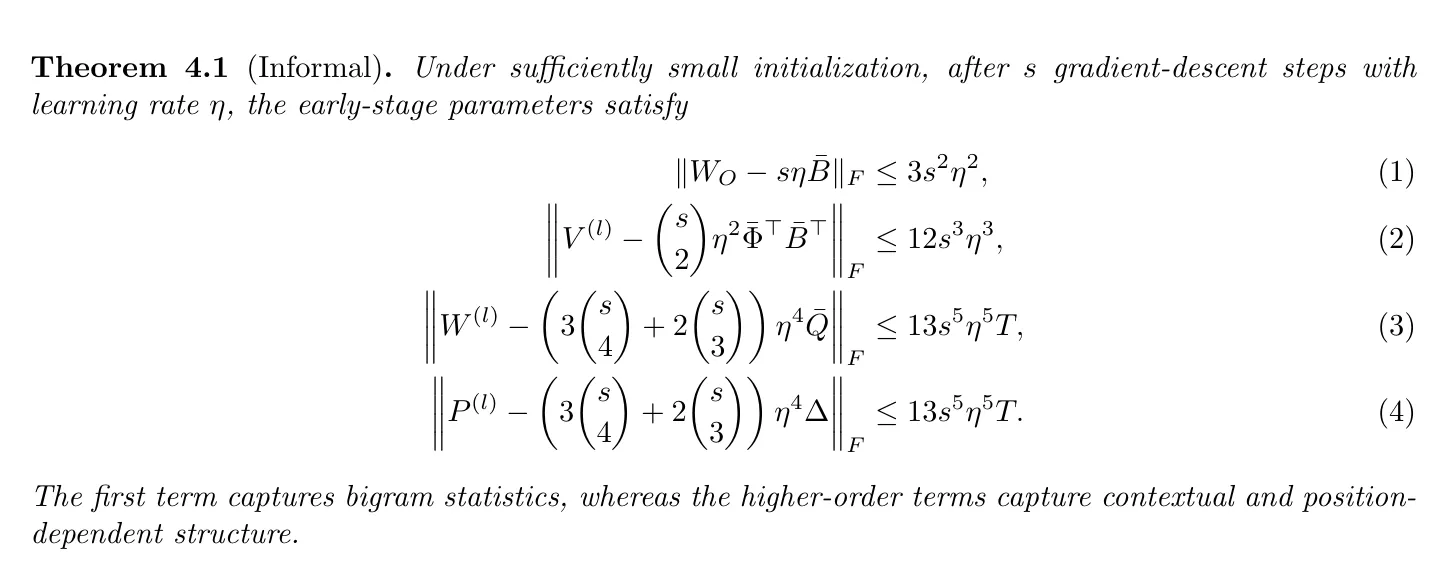
04. Short lemma / 短引理#
短引理适合证明链里的技术步骤:先给一条局部可复用结论,后续在 theorem proof 中调用。
\begin{lemma}[Softmax Jacobian Norm]
Let $\sigma:\mathbb{R}^n \to \mathbb{R}^n$ be the softmax map. Then
\begin{equation}
\|J_{\sigma}(z)\|_2 \le \frac{1}{2}
\end{equation}
for every $z \in \mathbb{R}^n$.
\end{lemma}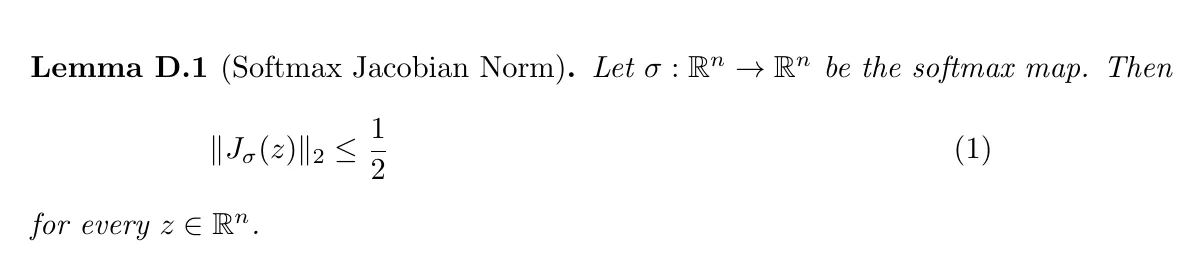
05. Lemma + proof / 引理与证明#
展示最常见的 proof 节奏:先写 lemma,再用 2—3 句证明核心因果链,而不是一上来堆细节。
\begin{lemma}[First Gradient Step]
After one gradient step,
\begin{equation}
W_O^{(1)} = W_O^{(0)} - \eta \nabla_{W_O}\mathcal L = \eta \bar B.
\end{equation}
\end{lemma}

\begin{proof}
At initialization all higher-order interaction terms vanish, so the gradient with respect to $W_O$ reduces to $-\bar B$. Substituting this quantity into the gradient update yields the claim.
\end{proof}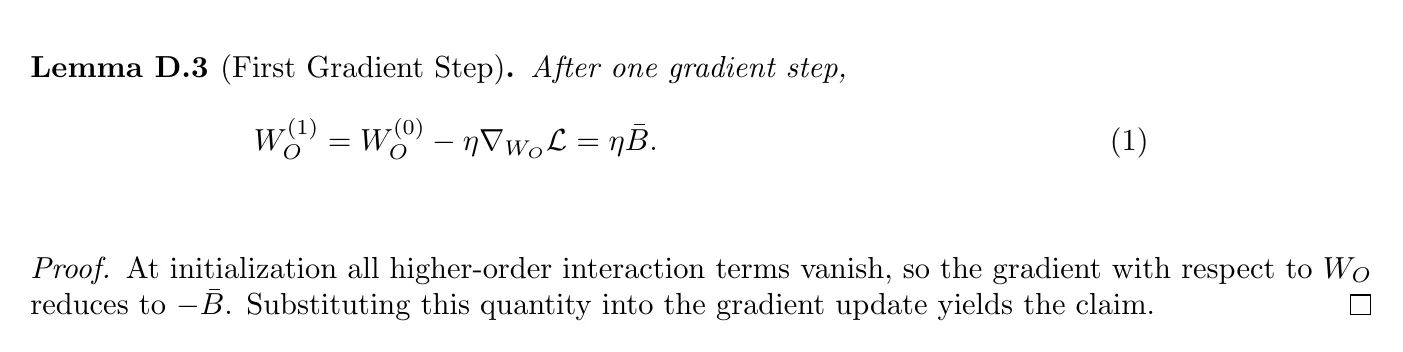
06. Run-in paragraph heading / 行内小标题#
适合在一节内部快速切换叙述焦点,不必新开 subsection。视觉上轻,但逻辑上很清楚。
\paragraph{Learning objective.}
We study the next-token prediction loss under a causal attention mask and track how its gradient reveals increasingly structured statistics over the course of training.
07. Numbered inline item / 编号式加粗说明#
适合拆解 theorem 中的多个成分:每一项先给标签,再给一句功能说明。
\noindent\textbf{(1) Bigram mapping $\bar B$.}
The matrix $\bar B$ summarizes adjacent token transitions and serves as the first feature learned by the output layer.
08. Bold-italic emphasis / 粗斜体强调句#
适合作为段首提示语,强调接下来不是纯推导,而是机制解释或结论总括。
\noindent\textbf{\textit{Three basis functions and their composition characterize the model's early behavior.}}
09. Formula + immediate explanation / 公式后立即解释#
这是“先给公式,再逐项解释符号功能”的标准写法。对读者最友好,也最容易迁移到自己的论文里。
To formalize this intuition, we decompose the training objective as
\begin{equation}
\mathcal E = \mathcal E_{\mathrm{signal}} + \lambda \mathcal E_{\mathrm{bias}} + \gamma \mathcal E_{\mathrm{noise}}.
\end{equation}
Here, $\mathcal E_{\mathrm{signal}}$ measures predictive structure, $\mathcal E_{\mathrm{bias}}$ captures systematic positional effects, and $\mathcal E_{\mathrm{noise}}$ collects residual variability.
10. From decomposition to theorem / 由公式过渡到定理#
展示“公式 -> 直觉解释 -> theorem”的自然过渡,特别适合理论论文正文主线。
The decomposition separates token-level statistics from positional effects, which suggests that the first nontrivial feature should appear in the output projection.

\begin{equation}
\Psi = \Psi_{\mathrm{token}} + \Psi_{\mathrm{position}}.
\end{equation}

This observation leads to the following theorem.

\begin{theorem}
Suppose the initialization scale is at most $\sigma_0$ and the learning rate is $\eta \le \eta_0$. Then the output projection recovers $\Psi_{\mathrm{token}}$ before any position-dependent parameter grows beyond order $\eta^2$.
\end{theorem}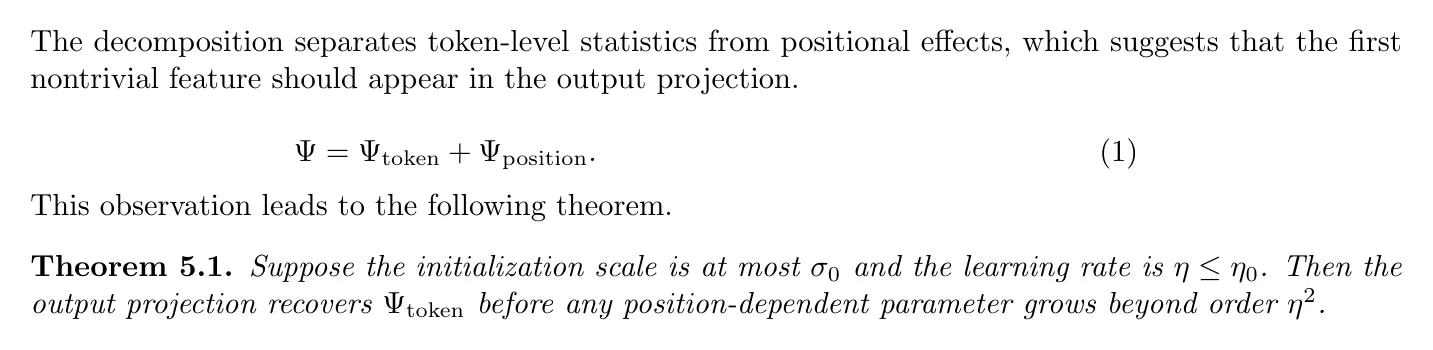
最后#
这组素材最适合当作写作时的“结构参考”:
- 写引言时,用 boxed question 把问题拎出来。
- 写正文时,用 definition 和 theorem 先固定对象与主结果。
- 写证明时,用 lemma 把技术步骤拆开。
- 写公式时,不只展示推导,还要立刻解释每一项在做什么。
好的理论论文不只是公式正确,还要让读者看清楚:问题是什么、对象是什么、结论靠什么成立,以及每一步推导在整条论证链里承担什么功能。
追加:Transformer 理论论文写作指南#
这一部分整理自一份更完整的 Transformer 理论论文写作指南。它不再提供单个 LaTeX 片段,而是把片段上升为“论文级写作模式”:如何提出 gap、如何描述公式、如何把 theorem 接回模型机制与实验验证。
三类 Transformer 理论论文写法#
| 类型 | 典型问题 | 写作重心 | 常见结构 |
|---|---|---|---|
| 表达能力 / 复杂度论文 | Transformer 能否更 succinct 地表示某类结构? | 定义对象、构造例子、给出 theorem / proposition / proof sketch | prose definition → example → theorem → proof sketch |
| 训练动力学 / 机制解释论文 | 训练早期参数如何学到 token association? | 定义模型、写出目标函数、展开 leading term、解释 theorem | definition → objective → update → informal theorem → interpretation |
| 数值精度 / 训练失效论文 | low precision 为什么导致训练不稳定? | 先定位故障,再用公式解释误差传播,并用实验验证 | notation → claim → derivation → remark → validation |
这三类论文的共性是:数学结果不是孤立出现的,而是嵌在一条叙述链里。
gap → object → formula → interpretation → theorem / claim → validation如果只写公式,不写它在这条链里的位置,读者会很难判断它为什么重要。
公式描述的 5 种模式#
理论论文里的公式,最好不要“裸奔”。一个关键公式前后,通常需要下面几类文字配合。
1. 预告型公式描述#
作用:先告诉读者这条公式要解决什么问题。
常用句式:
To formalize this intuition, we define ...
We now express this quantity as ...
To understand how the error propagates, we analyze ...
The following decomposition separates ... into ...可迁移模板:
Motivated by the discrepancy observed above, we express the error term as
\begin{equation}
E_t = \alpha\,\mathrm{diag}(\delta_t)\,K_t.
\end{equation}2. 符号解释型公式描述#
作用:公式后立即解释每个符号和每一项的角色。
常用句式:
Here, ... denotes ..., while ... represents ...
The first term captures ..., whereas the second term accounts for ...
where ||·||_F is ..., and B corresponds to ...可迁移模板:
Here, $\Psi$ denotes the context-summary statistic, while $B$ represents the local next-token mapping.
The product $\Psi^\top B^\top$ therefore combines long-range context aggregation with local predictive structure.3. 直觉解释型公式描述#
作用:不只解释“每一项是什么”,还解释“为什么这样写是合理的”。
常用句式:
Intuitively, this term increases when ...
In essence, Eq. (...) shows that ...
This expression reveals that ... is governed by ...
The asymmetry comes from ...可迁移模板:
Intuitively, the statistic grows when the token is repeatedly observed in similar prefix environments,
since both the local and contextual factors reinforce one another.4. 分解型公式描述#
作用:把复杂公式拆成多个组件,分别解释后再组合。
常用句式:
The decomposition consists of three components: ...
We walk through the construction in three steps.
The term ... corresponds to ..., while ... corresponds to ...可迁移模板:
We decompose the score into three parts:
\begin{align}
S &= S_{\text{local}} + S_{\text{context}} + S_{\text{position}},\\
S_{\text{local}} &= XBX^\top, \qquad
S_{\text{context}} = X\Psi^\top B^\top.
\end{align}
The first term captures immediate transitions, whereas the second term aggregates smoothed contextual evidence.5. 结论过渡型公式描述#
作用:把公式自然引到 theorem、claim 或 experiment。
常用句式:
This observation leads to the following theorem.
Based on this characterization, we obtain ...
We validate this prediction empirically in Section ...
This decomposition suggests ..., which we formalize below.可迁移模板:
This decomposition suggests a signed accumulation effect.
We formalize this below and validate it with targeted ablations in Section 4.一个关键公式的推荐顺序#
如果一条公式很重要,它几乎总应该按照下面的顺序出现:
1. 动机句:为什么需要这条公式
2. 公式:用 equation 或 align 给出对象
3. 符号解释:每个符号在做什么
4. 直觉说明:为什么这个量合理
5. 过渡句:引到 theorem / claim / experiment对应的 LaTeX 骨架:
\paragraph{Motivation.}
To formalize the contextual dependence discussed above, we introduce a corpus statistic that aggregates prefix evidence.

\begin{equation}
\Psi_{ij} = \cdots
\end{equation}

Here, $\Psi_{ij}$ denotes ..., while $\mu_j$ acts as a centering term.
Intuitively, the statistic is large when token $e_j$ appears repeatedly in the contexts of $e_i$.

This characterization allows us to express the leading term of the value matrix as $\Psi^\top B^\top$,
which leads to the following theorem.章节级模板#
一篇“理论 + 机制解释”型机器学习论文,可以按下面的顺序组织:
-
Introduction:先提出错位,再提出问题
不要只说“这个问题很重要”,而要说明“现有理论为什么不足以解释这个现象”。 -
Setup / Notation:给所有核心量找锚点
如果一个量会在 theorem 中反复出现,就应在前文被定义、命名并编号。 -
Main Characterization:先给局部对象,再给全局结论
先定义统计量、映射或误差项,再写 theorem / claim。 -
Interpretation:theorem 后必须解释意义
至少回答:这个结论意味着什么?它和 Transformer / attention / LLM 行为有什么关系? -
Mechanism / Proof Sketch:主文保留证明路线
技术细节可以放附录,但主文要保留 proof sketch、图示或关键因果链。 -
Experiments:实验写成 verification
图表最好直接对应 theorem / claim 中的变量、方向或预测。 -
Appendix:放完整证明和长细节
完整证明、技术引理、次要实验、长算法细节放到附录。
常用英文句式#
| 功能 | 句式 |
|---|---|
| 提出 gap | Despite recent progress on …, we still lack a principled account of … |
| 把现实问题转成数学对象 | To study this mechanism formally, we introduce … |
| 引入 notation | We begin by introducing the notation needed to define … |
| 第一次出现复杂公式 | We now express this quantity as … |
| 解释符号 | Here, … denotes …, while … represents … |
| 解释直觉 | Intuitively, this term increases when … |
| 分解公式 | The decomposition consists of three components: … |
| 引出 theorem | This observation leads to the following theorem. |
| theorem 后解释意义 | The above theorem shows that … |
| 连接实验 | We validate this prediction empirically in Section … |
| 说明主文 / 附录分工 | The formal statement and proofs are deferred to Appendix … |
最小可复用导言区#
适合中文或中英混排的理论 / 机制解释论文:
\documentclass[11pt,a4paper]{ctexart}
\usepackage[margin=1in]{geometry}
\usepackage{amsmath,amssymb,amsthm,mathtools,bm}
\usepackage{graphicx,booktabs,tabularx}
\usepackage{hyperref}
\usepackage{caption,subcaption}
\usepackage{listings}
\usepackage[most]{tcolorbox}
\usepackage[numbers]{natbib}

\newtheorem{theorem}{Theorem}[section]
\newtheorem{definition}[theorem]{Definition}
\newtheorem{lemma}[theorem]{Lemma}最小 theorem 单元模板#
\paragraph{Motivation.}
To formalize the intuition above, we define ...

\begin{equation}
...
\end{equation}

Here, ... denotes ..., while ... represents ...

\begin{theorem}[Informal]
...
\end{theorem}

\paragraph{Interpretation.}
The theorem shows that ...最小机制分析单元模板#
\paragraph{Localizing the failure.}
We first identify the unstable intermediate quantity ...

\begin{tcolorbox}[title=Claim]
...
\end{tcolorbox}

\begin{align}
...
\end{align}

This derivation shows that the update error is governed by ...

We validate this mechanism by ...写作检查清单#
结构检查#
- 是否明确提出了一个“旧尺度不足 / 旧设置不真实 / 旧方法缺机理”的 gap?
- main theorem 之前是否已经引入所有核心记号?
- theorem 后是否有解释段,而不是只有 proof?
- 主文是否保留了 proof sketch 或路线图?
公式检查#
- 第一条复杂公式前是否有动机句?
- 每个关键公式后是否有
Here, ... denotes ...? - 是否有
Intuitively, ...或This shows that ...的直觉解释? - 多步推导是否用
align暴露逻辑骨架? - 是否避免在 theorem 中第一次塞入过多新符号?
理论—实验闭环检查#
- 实验是否直接对应 theorem / claim 中的变量?
- 图注是否说明图在验证什么?
- 是否明确说明理论适用范围,如早期训练、小学习率、局部条件?
- 是否把数学结果重新翻译回 Transformer / attention / LLM 的实际含义?
最实用的一条经验#
如果一条公式在论文里很重要,它几乎总应当伴随三样东西一起出现:
- 预告句:告诉读者这条公式要解决什么问题。
- 符号解释:告诉读者每个符号在做什么。
- 直觉说明:告诉读者为什么这个式子合理。
缺少其中任何一项,读者的理解成本都会明显上升。